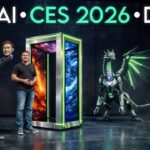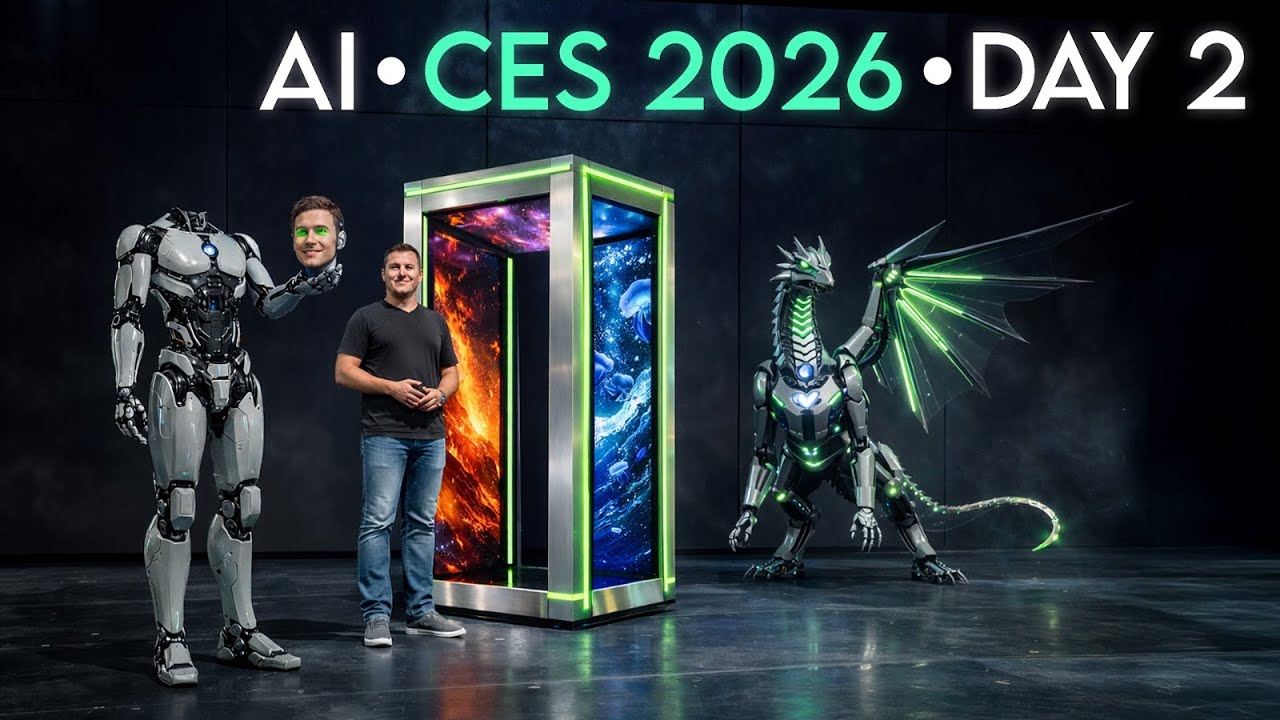
CES 2026 Day 2: Physical AI Steals the Show
Day two of CES 2026 made one thing clear: AI is no longer staying on screens. It’s moving into the physical world—robots, vehicles, machines, wearables, and infrastructure. What stood out wasn’t just flashy demos, but how mature many of these systems now feel.
From humanoid robots designed to work alongside people, to construction equipment running AI locally without cloud access, to autonomous cars powered by onboard supercomputers, CES shifted the conversation from “what’s possible” to “what’s ready.”
Here’s what actually mattered from day two.
Humanoid Robots Are No Longer a One-Off Experiment
Robotics dominated the floor, but not in the way it did a few years ago. This time, there wasn’t a single standout humanoid—there was an entire ecosystem.
Neurobotics showcased its next-generation 4NE1 humanoid with a clear focus on refinement. Movements were smoother, balance recovery looked more natural, and interactions felt controlled rather than mechanical. The robot is built to operate in human environments, without cages or barriers, which puts a premium on force sensing, perception, and safe motion.
Alongside it, Nura introduced a smaller humanoid designed for classrooms, labs, and tighter spaces. The key detail: both robots share the same intelligence stack. Skills learned on one platform transfer to the other, reducing development friction. Nura also presented a quadruped robot, quietly reinforcing an industry truth—two legs aren’t always the best solution. Terrain and task still dictate form.
Forier Intelligence approached humanoids from a completely different angle. Its GR3 robot is designed for care, rehabilitation, and healthcare settings. Movements are intentionally slow and predictable. In hospitals and assisted living environments, safety and trust matter more than speed. A smaller care-focused variant built on the same intelligence system followed the same pattern: one brain, multiple bodies.
Agabot took the broadest approach. Instead of a single robot, it revealed an entire lineup:
-
Full-size humanoids for navigation and interaction
-
Compact versions for education and social settings
-
Industrial humanoids focused on manipulation and load handling
-
A quadruped built for inspection and rough terrain
It also introduced OmniHand, a dexterous manipulation system aimed at fine motor tasks. The takeaway wasn’t novelty—it was maturity. This looked like a company thinking in product families, not prototypes.
Industrial AI Moves Out of the Cloud
Heavy industry made a strong showing, led by Caterpillar and its CAT AI system. Unlike many AI platforms, this one doesn’t rely on constant cloud connectivity. It runs directly on machines using Nvidia Jetson and Thor hardware.
That matters because construction and mining sites often operate with poor or no network access. CAT AI processes sensor data locally, offering real-time safety alerts, operator coaching, and performance insights. Machines share terrain, weather, and workflow data with each other, forming what Caterpillar described as a “digital nervous system” for job sites. In practice, that description fits. This is AI acting as infrastructure, not a feature.
Oshkosh Corporation applied a similar philosophy to aviation with autonomous airport tarmac robots. These machines assist with aircraft turnaround, ground coordination, and operations during extreme weather. Testing is already underway with major airlines, and deployments will start at large hub airports. Automation here targets one of the most time-critical environments in transportation.
Purpose-Built Robots, Not One-Size-Fits-All
Smaller platforms filled important gaps. Centiggen’s Rover X3 is a rugged inspection robot designed to climb stairs and navigate uneven outdoor terrain. It’s compact, stable, and built to carry sensor payloads rather than interact with people. The ability to move between levels without manual relocation removes a major deployment barrier for inspection and monitoring tasks.
In home robotics, Dream’s CyberX took a refreshingly mechanical approach. Instead of forcing a vacuum robot to solve stairs through software, CyberX physically carries it between floors using articulated tracks. It treats stairs as a hardware problem, not an algorithmic one—an approach that feels practical rather than theoretical.
Experimental Hardware Still Has a Place
CES also made room for bold hardware ideas. Flywing’s folding VTOL foam aircraft combined vertical takeoff with efficient fixed-wing flight. Built around a first-person-view system using DJI’s long-range wireless tech, the aircraft delivers an immersive, cockpit-style experience through head tracking.
With speeds approaching 75 mph and flight times up to an hour, it sits between traditional drones and fixed-wing FPV aircraft. At roughly $2,000 for the full kit, it’s aimed squarely at serious hobbyists rather than casual users.
Smart Glasses Finally Cut the Phone Cord
One of the more meaningful consumer shifts came from Raino’s X3 Pro smart glasses. These glasses don’t rely on a smartphone as a constant companion. Processing and connectivity are built in, allowing notifications, navigation cues, and assistant interactions to run directly on the device.
The display is intentionally minimal—short prompts, alerts, translations—designed not to block vision or demand attention. Rather than trying to deliver full augmented reality, the X3 Pro functions as a lightweight AI interface. It feels less like an AR headset and more like a wearable AI terminal, which makes it far easier to imagine using every day.
Consumer Tech Turns Practical Again
Several products leaned into usefulness over hype.
-
Clicks introduced a communicator phone with a physical keyboard, targeting users who care about typing precision and control.
-
Bird Buddy 2 Mini brought AI-powered bird recognition into a smaller, more affordable smart feeder.
-
Luna Band removed the screen entirely, offering health tracking without constant notifications or subscriptions.
-
Timely Flashlight combined GPS, LTE, video, and emergency response into a serious personal safety tool.
-
Shokz OpenFit Pro earbuds improved sound while keeping users aware of their surroundings.
Power and mobility intersected with Bluetti’s Charger 2, capable of delivering up to 1,200 watts directly from a vehicle—far beyond standard outlets. It supports bidirectional power flow, making it useful for off-grid travel, mobile work, and emergency setups.
Even pet care got smarter with Clever K9’s connected dog crate, which monitors environmental conditions and can automatically unlock during emergencies.
Health Tech Steps Into Prevention
Withings Body Scan 2 stood out by measuring over 60 biomarkers in about 90 seconds. By tracking cardiovascular, nerve, vascular, and metabolic indicators, it positions itself as preventative health technology rather than a fitness gadget. The focus is on long-term trends, not daily scores.
AI Moves Directly Into Cars
Automotive tech leaned heavily into AI integration. Ford outlined a clear roadmap, starting with an AI voice assistant inside its mobile app before expanding directly into vehicles.
Unlike basic infotainment systems, this assistant has access to vehicle-specific data. Drivers can ask about oil life, tire condition, battery health, range, and maintenance using natural language. Ford also confirmed its next EV platform, launching in 2027, will reduce hardware costs and complexity by about 30%.
Eyes-off driving is targeted for 2028, with Ford developing much of its computing and electronic architecture in-house for tighter control and longer software support.
Level 4 Autonomy, Built Around Compute
Tensor approached autonomy from the opposite direction—starting with computing power and building the vehicle around it. Its level four autonomous car features an onboard supercomputer delivering over 8,000 trillion operations per second, powered by eight Nvidia Drive AGX Thor chips.
The vehicle uses overlapping lidar, camera, and radar systems to ensure redundancy. Tensor already holds one of California’s earliest driverless testing permits, with nearly nine years of development behind the platform. Deliveries are planned for late 2026, with real-world deployment expected in 2027 through direct integration with Lyft’s ride-hailing platform.
The Big Picture
CES 2026 Day 2 wasn’t about futuristic concepts. It was about systems that feel ready to operate in the real world—robots designed for specific jobs, AI running locally where it has to, and consumer tech focused on reducing friction rather than adding screens.
Physical AI isn’t coming next decade. It’s already here—and it’s starting to look practical.