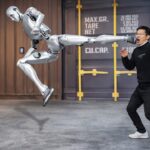
Artificial intelligence is no longer just assisting human creativity. In some areas, it’s actively inventing things on its own—sometimes producing results that outperform human designs, even when researchers can’t fully explain how the system arrived there.
These aren’t science fiction concepts or future predictions. Many of these AI-created inventions are already deployed, tested, and in real-world use. What makes them unsettling—and fascinating—is that performance is now outpacing understanding.
Here are 15 real inventions created or discovered by AI, starting with the most surprising.
13. AI-Generated Algorithms Humans Can’t Fully Explain
This is already happening quietly across research labs and industry.
AI systems are now generating algorithms that outperform human-designed ones in areas like optimization, scheduling, and neural network architecture. The results are measurable, repeatable, and benchmarked—but the logic inside the model doesn’t map cleanly to human reasoning.
Engineers can verify that the algorithm works. What they often can’t do is explain why it works as well as it does.
This marks a historic shift: for the first time, humans are deploying systems where understanding lags behind performance. The gap is small for now—but it’s real.
12. AI-Invented Medical Imaging Reconstruction Methods
AI hasn’t just made medical scans faster or clearer. It has changed how images are reconstructed from raw data.
In MRI and CT imaging, AI-based reconstruction techniques now reduce scan times and, in some cases, radiation exposure—while preserving or improving diagnostic accuracy. Hospitals are already using these systems.
What’s important here is that the underlying mathematics of image formation has changed. AI is recovering details that were previously lost in noise, opening new possibilities for diagnosis rather than just visual improvement.
11. AI-Designed Chemical Catalysts
Catalysts rarely make headlines, but they sit at the core of global industry—fuel production, fertilizers, plastics, and pharmaceuticals all depend on them.
AI models are now designing and screening new catalysts far faster than traditional lab methods. Instead of physically testing thousands of candidates, researchers use AI to predict which molecular structures are most likely to work, then validate only the most promising ones.
Even small efficiency improvements matter here, because these reactions occur billions of times every day worldwide.
10. AI-Generated Antenna Designs That Look Wrong—but Work Better
Some of the strangest AI inventions come from antenna design.
Using evolutionary algorithms, AI systems generated antenna shapes that look chaotic and uneven—nothing like what engineers would normally create. Yet when tested, some of these antennas outperform traditional designs.
NASA and aerospace organizations have documented this approach in real missions. These designs weren’t copied or guessed. They evolved through simulation, selection, and iteration—reaching solutions humans wouldn’t naturally try.
9. AI-Designed Solar Panel Layouts
Solar panels may look simple, but layout plays a huge role in efficiency.
AI systems have optimized solar cell arrangements using irregular, non-symmetrical patterns that capture more light under real-world conditions. These layouts challenge the long-held assumption that symmetry equals efficiency.
Side-by-side tests show measurable gains in energy capture—even though the AI designs often look messy or unintuitive.
8. AI-Generated Metamaterials
Metamaterials derive their properties from structure rather than chemistry—and AI excels at designing them.
Researchers have used AI to generate geometric lattice designs that bend light, absorb sound, or control vibrations in ways natural materials cannot. Many of these shapes appear inefficient or random at first glance.
Simulations and lab tests show they behave exactly as predicted. These materials are already being studied for use in optics, acoustics, and mechanical engineering.
7. AI-Invented Mechanical Structures
In mechanical engineering, AI-driven topology optimization produces parts that look unfamiliar—but perform better.
Instead of clean beams and straight supports, AI removes material wherever it isn’t strictly needed. The result is components that are lighter, stronger, and often more durable than traditional designs.
Many of these structures have already been manufactured using 3D printing and advanced fabrication methods.
6. AI-Generated Architectural Designs
AI systems can now generate architectural designs that are structurally valid and optimized for airflow, daylight exposure, and material efficiency.
Rather than replacing architects, these tools expand the early design phase—producing hundreds of viable concepts based on climate, space constraints, and usage goals.
Most remain experimental, but some are already influencing real-world planning decisions. Visually, they tend to look organic, almost grown rather than drawn.
5. AI-Discovered New Materials
Material science has become one of AI’s strongest domains.
Machine learning models can screen millions of possible compounds and predict which ones might have useful properties like high conductivity or heat resistance. Many of these materials were never previously cataloged.
Researchers then synthesize the most promising candidates in the lab, dramatically reducing discovery time compared to traditional trial-and-error approaches.
4. AI-Designed Battery Chemistries
Battery development is slow and expensive—but AI is accelerating it.
Models analyze massive datasets from past experiments and simulations to predict new electrode and electrolyte combinations that could improve energy density, charging speed, or stability.
Human researchers still build and test the batteries. AI simply tells them where to look first—and that guidance alone can save years of work.
3. AI-Generated Aircraft Components
In aerospace, weight is everything.
Companies like Airbus now use AI-driven generative design to create aircraft components. Engineers define performance constraints, and AI generates structures that meet them—often removing material in places humans wouldn’t think to touch.
Several of these components have already been manufactured, tested, and deployed. The designs look skeletal and organic—but they work.
2. AI-Designed Microchips
Modern chips are too complex for humans to optimize manually.
DeepMind trained reinforcement learning systems to design chip floor plans, optimizing for performance, power usage, and efficiency. The AI produced layouts faster than human teams—and matched or exceeded their quality.
Google confirmed these systems were used for real, production-scale chip design problems, not just experiments.
1. AI-Designed Drugs Entering Human Trials
Drug discovery is one of the slowest and most expensive scientific processes.
AI is changing the earliest stages by generating novel drug candidates based on biological targets. Companies like Insilico Medicine have already advanced AI-designed molecules into human clinical trials.
In these cases, AI proposes the molecular structure. Human researchers validate, test, and refine it—but the initial invention comes from the machine.
The Pattern Is Clear
Across engineering, medicine, energy, and science, AI is no longer just optimizing human ideas. It’s exploring design spaces humans rarely enter, producing results that work—even when they don’t make intuitive sense.
This doesn’t mean humans are being replaced. But it does mean invention itself is changing.
For the first time, we’re living in a world where machines are creating things faster than we can fully explain them—and that may be the most important invention of all.