Humanoid robots didn’t just appear at CES 2026.
They dominated it.
One robot threw flying kicks, landed clean backflips, and smashed sandbags like it was a routine workout. Another calmly discussed the AI boom on live television. Meanwhile, Boston Dynamics rolled out a new version of Atlas with real production timelines, public specs, and confirmed customer shipments.
This wasn’t a showcase of future ideas.
It was a statement: humanoid robots have moved past demos and into deployment.
Unitree’s H2 Looks Less Like a Prototype — And More Like a Worker
Unitree’s latest training video featuring its H2 humanoid didn’t feel staged or dramatic. That was the surprising part. The robot moved with the relaxed confidence of something already comfortable in its body.
Then the motion began.
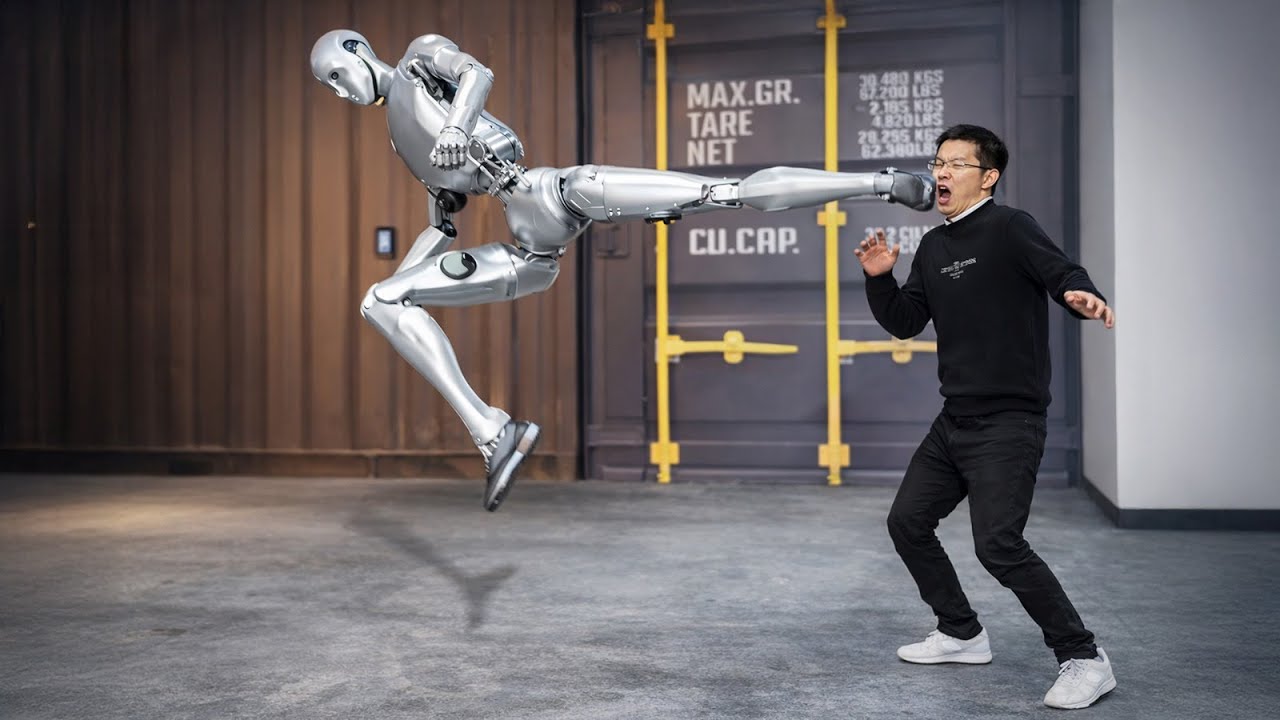
Flying kicks that fully left the ground.
Backflips with stable landings.
Repeated sandbag strikes that visibly shifted the target.
Each movement flowed into the next without hesitation or awkward recovery. Nothing looked improvised or corrective. The robot wasn’t reacting — it was executing.
The H2 stands about 180 cm (6 feet) tall and weighs roughly 70 kg (154 lbs). Those proportions matter. Unlike earlier humanoids with awkward limb ratios, the H2 mirrors the human body closely. Long legs, balanced torso, properly aligned shoulders. When it moves, the motion feels intentional, not compensatory.
More Joints, More Control, More Confidence
Under the hood, the H2 operates with 31 degrees of freedom, up from 26 in Unitree’s earlier R1 model.
-
12 joints in the shoulders (6 per arm)
-
3 joints in the torso
-
14 joints across both legs
-
2 additional stabilizing joints
That extra articulation shows up immediately. The torso twists naturally. Kicks extend further. Balance recovers instantly after high-impact landings.
Each joint delivers up to 360 Newton meters of torque, giving the robot explosive power without sacrificing control. High torque alone doesn’t create smooth motion — coordination does. Unitree’s control algorithms clearly manage timing, force, and balance across the entire body in real time.
Quiet Upgrades That Matter More Than Acrobatics
The flashy moves grabbed attention, but the quieter changes matter more for real-world use.
The H2’s arms now feature seven degrees of freedom, and the hands have been redesigned for better dexterity. That pushes the robot beyond performance demos and toward practical tasks: gripping tools, handling objects, and interacting with physical environments.
Factory floors, logistics hubs, and structured workspaces start to make sense when a humanoid can move and manipulate with precision.
Unitree has also expanded its teleoperation system, allowing humans to control robots in real time using wearable rigs and mixed-reality headsets, including devices like Apple Vision Pro. Every teleoperated session doubles as training data, accelerating improvement while keeping humans in the loop.
A Robot Discussing AI on Live TV Felt… Normal
While the H2 video spread online, Unitree made headlines in a very different way.
During a CNBC segment, a G1 humanoid named Koi joined a conversation about the AI boom. Asked whether today’s AI surge was a bubble or a long-term shift, Koi gave a measured, balanced response — the kind you’d expect from a human analyst.
That moment landed differently. Not because the answer was extraordinary, but because it wasn’t.
Koi runs on Unitree’s G1 platform, weighs around 77 lbs, and has 23 degrees of freedom, enabling coordinated movement, martial arts routines, and expressive gestures. One earlier demo even went viral when an operator accidentally kicked himself while the robot mirrored his motion in real time.
These Robots Are Already for Sale
The G1 isn’t locked in a lab.
Unitree sells the G1 in the U.S. through its official distributor, with prices ranging from $8,990 to $128,900, depending on configuration. These robots ship. They operate outside research facilities. They already exist in real environments.
According to industry leaders, the long-term goal is clear: reduce physical strain, improve efficiency, and handle repetitive or hazardous tasks across industrial and eventually domestic settings.
Boston Dynamics’ New Atlas Is Built for Industry, Not Spectacle
While Unitree pushes agility and performance, Boston Dynamics is optimizing for reliability and scale.
At CES 2026, the company unveiled a stationary prototype of its next-generation Atlas humanoid, and the design choices were telling.
-
Wider hips and longer legs for better stride dynamics
-
Offset limb connections to increase range of motion
-
Four-finger hands replacing the earlier three-finger design
-
Just two unique actuator types across the entire robot
Boston Dynamics fully transitioned to rotary actuators, prioritizing durability and serviceability. According to the company, a limb can be swapped in under five minutes — a detail that matters on factory floors.
Real Specs, Real Deployments, Real Timelines
The new Atlas reportedly features:
-
56 degrees of freedom
-
Fully rotational joints
-
2.3 meters (7.5 ft) of reach
-
50 kg (110 lbs) lifting capacity
-
Operation from -20°C to 40°C
-
Strong water resistance
Production begins immediately at Boston Dynamics’ headquarters. All 2026 deployments are already committed, with fleets shipping to Hyundai and Google DeepMind. Additional customers follow in 2027.
Hyundai plans to scale production to 30,000 units per year by 2028, signaling serious industrial intent.
Boston Dynamics and Google DeepMind also confirmed a partnership to integrate Gemini robotics AI models directly into Atlas, combining advanced hardware with frontier perception and reasoning systems.
CES 2026 Marked a Turning Point
CES 2026 wasn’t about concepts. It was about commitments.
Reports show humanoid robots dominating the show floor, with China presenting the largest concentration of deployable systems. Many exhibitors showcased robots with pricing, supply chains, and delivery schedules — not prototypes behind glass.
That shift tells the real story.
Humanoid robotics has moved beyond novelty.
Production, customers, and infrastructure now define the category.
Why This Moment Matters
Robots are no longer confined to labs or viral clips.
They appear on factory roadmaps.
nancial television.
=”6864″ data-end=”7037″>Unitree is reportedly exploring an IPO valued as high as $7 billion, reflecting growing confidence in humanoid robotics as a commercial market, not a science experiment.
The trajectory is becoming hard to ignore.
Humanoid robots are entering public, industrial, and commercial spaces — fast.
And CES 2026 made one thing clear: this transition is already underway.