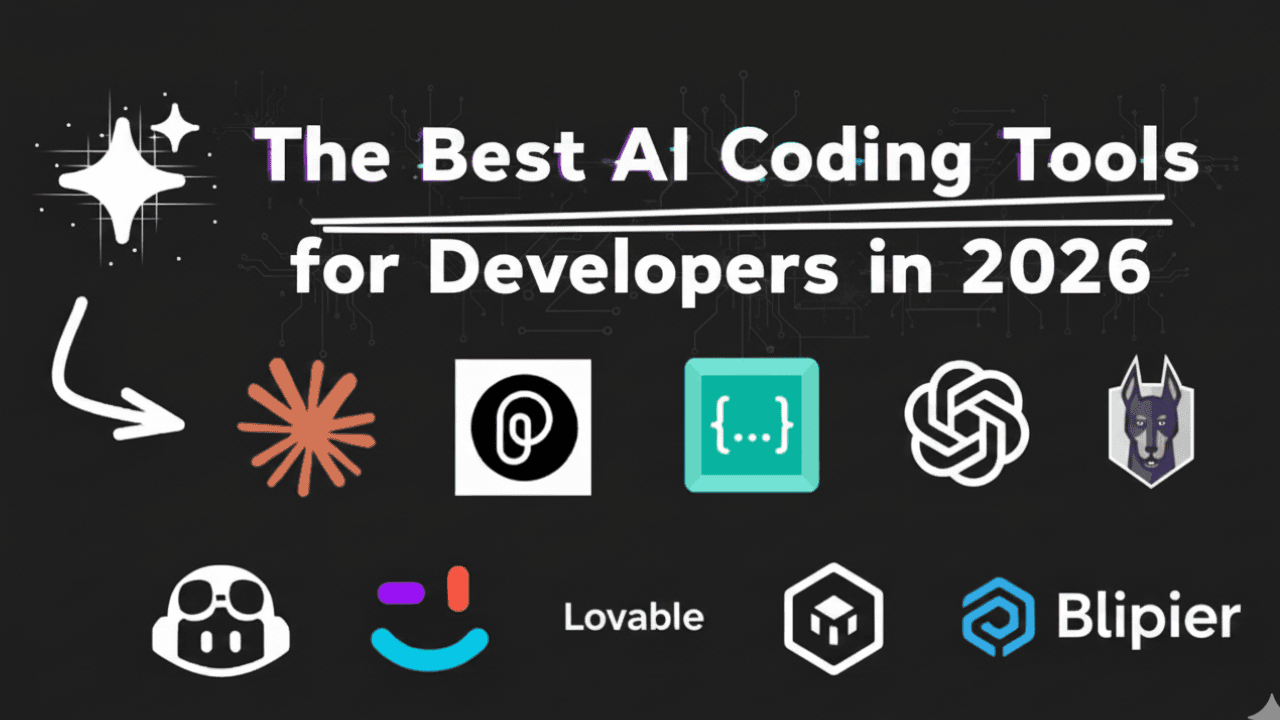
I’ve tested a lot of AI tools over the past few years. At this point, I’ve reviewed well over 30 different AI products, built projects with them, and even made full videos breaking them down. But instead of listing everything under the sun, I want to talk about something more useful: the best AI for coding that I actually use every single day.
These are the tools that are always open on my computer, the ones that genuinely improve my productivity as a developer—not just tools that look good in demos.
Let’s break them down.
Cursor vs Windsurf: My Daily Coding IDEs
When it comes to choosing the best AI for coding inside an IDE, Cursor is currently my go-to.
Cursor shines when I’m working on hybrid projects—anything with a backend, frontend, APIs, and multiple moving parts. It feels like a traditional developer environment, but with AI deeply integrated. I can ask it to refactor code, add features, or explain complex logic without losing control of my files.
I also use Windsurf, another AI-powered editor. When Windsurf first launched, it actually outperformed Cursor in a few areas. But Cursor has evolved fast. Today, it has matched—and in some cases surpassed—those early Windsurf advantages.
That said, this space changes quickly. If Windsurf ships a big update tomorrow, I wouldn’t be surprised if I switch again. That’s just how fast the best AI for coding ecosystem is moving.
Why I Still Prefer AI IDEs Over “One-Click” Builders
Even with all this AI power, I still want full control over my code.
AI IDEs like Cursor don’t replace developers—they amplify them. I can inspect every change, move files manually, and adjust logic exactly how I want. That’s why I prefer these tools over fully automated site or app generators for serious development work.
ChatGPT: Still the Most Used AI Tool in My Workflow
If I had to pick one tool that gets the most screen time, it’s easily ChatGPT.
While it’s not always the most specialized tool, it’s one of the most versatile—and that’s why it earns a spot among the best AI for coding tools.
I use ChatGPT for:
-
Writing and reviewing code
-
Debugging logic
-
Drafting emails and documentation
-
Reviewing resumes and contracts
-
Planning projects
-
Scripting videos
-
Answering random technical questions
The real advantage is context. I’ve been using ChatGPT since its early days, so it already understands how I work, what I build, and what I care about. That long-term context makes its answers far more relevant than newer tools that don’t “know” me yet.
It’s open on my phone, my laptop, and usually a second monitor—pretty much all day.
Whisper Flow: The Fastest Way to Talk to AI While Coding
One of the most underrated productivity boosters is voice input, and Whisper Flow has completely changed how I interact with AI.
It’s hands-down the fastest and most accurate dictation tool I’ve used. With a simple keyboard shortcut, I can start talking—and it works in any app, not just editors.
Why this matters:
-
I type around 60–70 words per minute
-
With Whisper Flow, I speak close to 190 words per minute
-
My prompts are longer, clearer, and more detailed
That alone makes it a serious contender for anyone searching for the best AI for coding productivity.
Even better, it understands context inside tools like Cursor and Windsurf, letting me reference files and variables while dictating. That’s a huge upgrade over standard voice typing.
Deep Agent by Abacus AI: For Complex, Long-Running Tasks
When I need AI to handle big, multi-step problems, I use Deep Agent.
This is not a quick-response chatbot. It’s built for:
-
Research-heavy tasks
-
App generation
-
Document creation
-
Deep internet searches
-
Long-running workflows
I’ve used it to design apartment interiors, analyze construction timelines near my building, and even build custom applications for students. These are tasks that most “instant” AI tools simply can’t handle well.
For deep, agent-based reasoning, it’s one of the strongest tools I’ve used.
Warp: The Best AI for Coding in the Terminal
Warp is essentially an AI-powered terminal, and it’s perfect for backend work, automation, and deployments.
I use it heavily for:
-
Docker and containerization
-
Kubernetes workflows
-
Backend automation
-
Building bots and scripts
One standout feature is parallel agents. I can run multiple AI tasks at the same time in different tabs, which feels like having multiple assistants working in parallel.
When I’m deep in backend or DevOps work, Warp easily qualifies as one of the best AI for coding in terminal-based environments.
Lovable: Fast Frontend and Landing Page Generation
Lovable is the tool I reach for when I need:
-
Landing pages
-
Simple marketing sites
-
Basic frontends
I don’t use it for full-stack apps, but for quick designs, it’s excellent. I used it to generate an entire landing page for one of my projects, then moved the code into Cursor to refine it further.
That workflow—generate fast, then polish manually—works extremely well.
TL;DV: AI Meeting Notes I Can’t Live Without
TL;DV automatically joins my Zoom and Google Meet calls, records everything, and generates summaries and transcripts.
What makes it powerful is automation:
-
It pushes meeting recordings to Discord
-
It integrates with Zapier
-
It lets me reuse transcripts with ChatGPT for deeper analysis
It’s not strictly a coding tool, but it saves me hours every week—and productivity matters just as much as code.
Blitzy: AI That Thinks Like a Senior Developer
Blitzy is very different from most AI tools.
Instead of instant results, it:
-
Analyzes your entire codebase
-
Generates massive technical documentation
-
Takes hours or even days to complete tasks
-
Produces extremely thorough results
I’ve used it to generate hundreds of thousands of lines of code and deep architectural documents. It’s slow—but incredibly thoughtful.
If you want AI that behaves more like a senior engineer than a chatbot, Blitzy is worth exploring.
Zapier: The Glue That Connects Everything
Zapier isn’t strictly an AI tool, but it connects almost all of mine.
From meeting automation to notifications and workflow triggers, it quietly powers a huge part of my system. I run over 100 automations, many tied directly to AI outputs.
Final Thoughts: What Is the Best AI for Coding?
There’s no single “best AI for coding” for everyone.
For me:
-
Cursor is my daily coding environment
-
ChatGPT is my universal assistant
-
Whisper Flow multiplies my speed
-
Deep Agent handles complex reasoning
-
Warp dominates backend and terminal work
The real advantage comes from using the right AI for the right task, not chasing every new tool.
If you take one thing away from this article, let it be this:
The best AI for coding isn’t the one with the most hype—it’s the one that fits seamlessly into how you already work.