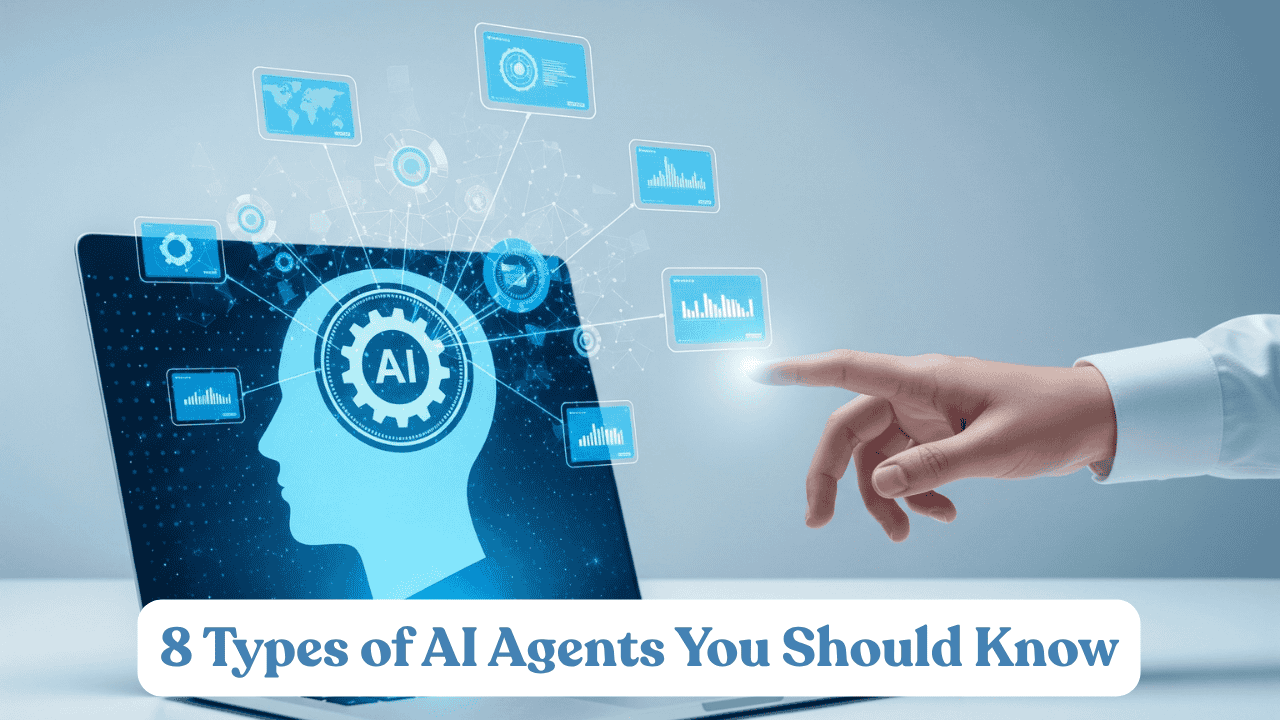
Artificial Intelligence has come a long way. AI agents today are not just about chatting or generating text — they can reason, see, plan, and act. From large reasoning systems to vision-based models, every AI agent type is built for a specific purpose.
In this article, we’ll explore the 8 main types of AI agents that are shaping the future of technology.
1. GPTs – General-Purpose Text Generators
GPTs (like GPT-5 or Gemini) are language models designed to understand and generate human-like text.
They can write essays, answer questions, summarize content, and even code.
These models are known for their fluency, adaptability, and versatility, making them ideal for chatbots, creative writing, and business automation.
Example use: Chat assistants, content creation tools, email writers.
2. MoE – Mixture of Experts
MoE (Mixture of Experts) models are like AI teams working together. Instead of using one large network for every task, they route questions or commands to the best “expert” inside the system.
This design makes them more efficient and faster while using less computing power.
Example use: Large-scale AI systems that handle many types of requests at once, such as recommendation engines or complex analytics tools.
3. Large Reasoning Models (LRMs)
These AI agents are built for deep logical thinking and problem-solving.
They focus on multi-step reasoning, meaning they can handle complex questions that need several layers of thought.
Large Reasoning Models aim to think more like humans — understanding not just the answer, but how to reach it.
Example use: Research assistance, legal or financial analysis, and science-based problem solving.
4. Vision-Language Models
Vision-Language Models (VLMs) combine visual understanding with language generation.
They can look at an image and describe it, answer questions about it, or even generate matching visuals.
These models bridge the gap between what AI can see and what it can say.
Example use: Image captioning, visual search, and multimodal chat systems.
5. Small Language Models (SLMs)
Not every AI needs to be massive. Small Language Models are lightweight versions designed for speed, privacy, and cost-efficiency.
They run locally on smaller devices and are perfect for simple or offline tasks.
Example use: On-device assistants, mobile chatbots, and IoT applications.
6. Large Action Models (LAMs)
Large Action Models are a new kind of AI that doesn’t just talk — it acts.
They can execute code, call APIs, and perform real-world tasks automatically.
Imagine an AI that reads an email, understands the request, and books your flight or sends a reply — that’s what LAMs are built for.
Example use: AI automation, coding assistants, and autonomous agents that manage digital workflows.
7. Hierarchical Language Models (HLMs)
Hierarchical Language Models are designed for long-term planning.
They break down big problems into smaller parts and solve them step by step.
This structure helps them handle tasks that need strategy and patience, such as multi-day reasoning or planning systems.
Example use: Strategic AI planners, simulation models, and complex research automation.
8. Large Concept Models (LCMs)
Large Concept Models focus on abstract thinking and generalization.
Instead of learning surface-level patterns, they understand high-level ideas and relationships between concepts.
These models help AI connect knowledge from different fields, making them closer to human-like understanding.
Example use: Advanced AI research, creative content generation, and concept discovery.
The Future of AI Agents
AI agents are moving beyond simple text tasks. The next generation will combine reasoning, action, and perception — allowing systems to see, think, and do.
Future AI ecosystems may use multiple agent types together, such as a Vision-Language Model guiding a Large Action Model, or a Small Model summarizing data for a larger one.
As technology advances, these specialized agents will make AI more collaborative, efficient, and human-like in its decisions and behavior.
FAQ: 8 Types of AI Agents
1. What is an AI agent?
An AI agent is a system that can understand inputs, process information, and take action or respond intelligently.
2. Which type of AI agent is used in ChatGPT?
ChatGPT uses a GPT-based model, which is a general-purpose language agent trained for text understanding and generation.
3. What is the difference between GPT and MoE models?
GPTs use one large model for all tasks, while MoE models use multiple specialized parts (experts) that handle different kinds of problems.
4. Can AI agents work together?
Yes. Many advanced systems combine multiple agent types to achieve better performance, such as reasoning agents working with action or vision models.
5. Which AI agent is best for automation?
Large Action Models (LAMs) are best for automation because they can execute tasks, run code, and connect to tools like APIs or databases.
Final Thoughts
AI agents are no longer just chatbots — they are evolving into systems that can see, think, act, and plan.
Understanding these 8 types helps us see how artificial intelligence is moving toward becoming more capable and more human-like every day.
From GPTs that write content to LAMs that execute real tasks, each type of AI agent plays a key role in building the intelligent systems of tomorrow.