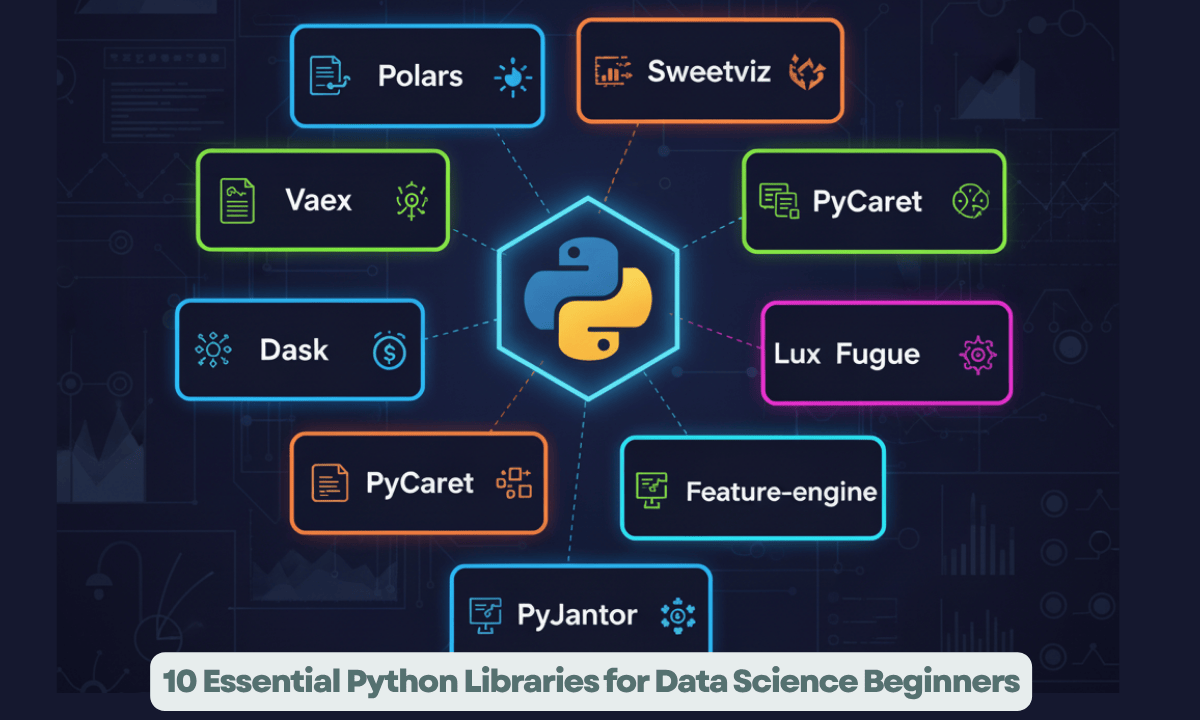
Best Python Libraries for Data Science
Data is the core of every modern industry. From entertainment and sports to finance and research, every decision today is guided by insights hidden in data. Python remains the most popular programming language for data science because it is simple, flexible, and rich with powerful libraries. Tools like Pandas, NumPy, and Matplotlib are widely known, but many other Python libraries for data science are equally impressive and often overlooked.
This guide explores some lesser-known yet highly useful Python libraries that can improve speed, simplify complex workflows, and unlock deeper insights.
Underrated Python Libraries for Data Science You Should Know
1.Polars
Polars is a blazing-fast DataFrame library built in Rust. It handles large datasets smoothly and outperforms Pandas in many real-world workloads. When you are working on heavy computations or massive CSV files, Polars saves time and system memory.
2.Vaex
Vaex specializes in out-of-core computing. It analyzes billions of rows without loading them entirely into memory. This makes it perfect for large-scale analytics, such as website traffic logs or scientific data.
3.Sweetviz
Sweetviz generates automated, visually rich EDA reports. Within seconds, you can explore distributions, feature comparisons, and relationships. This is helpful when you want a quick overview before deeper analysis.
4.Dask
Dask brings parallel computing to Python. It breaks your tasks into smaller chunks and executes them simultaneously. This is ideal for handling huge DataFrames or accelerating machine learning workflows.
5.PyCaret
PyCaret simplifies machine learning experimentation. You can test multiple models, compare performance, and tune hyperparameters using minimal code. It is great for students, analysts, and professionals who want quick results.
6.Fugue
Fugue allows you to run the same Python code on Pandas, Spark, or Dask without rewriting logic. If your project scales later, you can move from local development to big-data systems easily.
7.Lux
Lux automatically recommends the best visualizations for your dataset when you view a Pandas DataFrame. It saves you time spent manually creating charts and helps uncover hidden patterns faster.
8.Feature-engine
This library focuses entirely on feature engineering. It offers ready-made methods for encoding variables, handling missing data, removing outliers, and improving dataset quality for machine learning.
9.Yellowbrick
Yellowbrick adds visual diagnostics to scikit-learn. Instead of reading raw metrics, you can evaluate model performance through interpretable, high-quality visual graphs.
10.PyJanitor
PyJanitor helps streamline data cleaning with simple, readable functions. Renaming columns, removing duplicates, and reshaping data become much faster and more intuitive.
Why These Python Libraries Matter
These Python libraries for data science make workflows smoother, faster, and more scalable. Whether you need powerful visualizations, efficient big-data processing, or automated machine learning support, each tool brings its own advantage. Together, they enhance productivity and allow data professionals to focus more on insights rather than manual tasks.
FAQs on Python Libraries for Data Science
What are the most essential Python libraries for data science?
Pandas, NumPy, Matplotlib, SciPy, scikit-learn, and TensorFlow remain core essentials for most data science tasks.
Which Python library is best for handling big datasets?
Vaex and Dask are great choices because they process large datasets efficiently without consuming excessive memory.
Which library is best for fast DataFrame operations?
Polars is currently one of the fastest options due to its Rust-based architecture.
Which Python library is best for automated visualizations?
Sweetviz and Lux provide instant insights and suggested charts with minimal code.
Is Python still relevant for data science in 2025?
Yes. Python continues to dominate due to its ecosystem, community, ease of learning, and constant innovation.
Final Thoughts
The world of data science evolves quickly. While familiar tools remain important, exploring the lesser-known Python libraries for data science can unlock new speed, clarity, and creativity in your projects. Whether you work with small datasets or billions of rows, these libraries help you analyze data more efficiently and build smarter solutions.